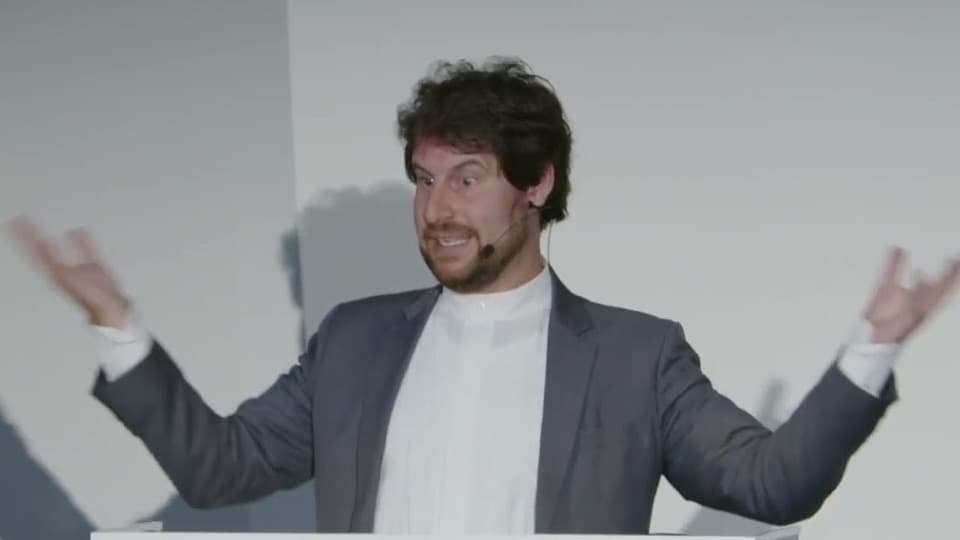
Rahim Taghizadegan at BTC Prague 2026
Don't bank on one location.
Nineteen minutes on uncertainty, the Bitcoin citadel meme, why most intentional communities fail, and the realisation that led to citadel.garden. Recorded on stage at BTC Prague in June 2026.
Transcript
The talk in full.
Lightly edited from the recording, in the speaker’s own words.
Intro
Hello everyone. Thanks for being here. I have to say up front, I'm really exhausted. It's a great event as always. There's a lot of interest at citadel.garden, I'm speaking all the time, but of course I'm really exhausted from this year.
A crazy year of uncertainty
It's been a crazy year. I'm sure every one of you has felt it. There's so much uncertainty in the air. And for me it was even worse. I'd say I have family ties to Iran and Lebanon, like the worst places to be right now. I've been in the AI rabbit hole for many years already, which is its own craziness and speed. I'm an investor, so I'm exposed to the volatility of the markets. It's been a terribly crazy year.
But of course, as an economist, I know this uncertainty is not just created. It doesn't appear overnight. It appears subjectively in our minds. For me it felt like the years of the pandemic, you know, suddenly: what's happening? What's going on? When we feel this uncertainty, like we don't know what crazy thing can happen tomorrow again, and we're less and less surprised about the craziness of things happening, it just means that we have allocated our wrong certainty before.
Wrong certainty was trust
We've lived with a wrong certainty before, and a lot of that wrong certainty was trust. Trust in institutions, trust in systems, trust in promises. In particular in privileged Western countries that are known as high-trust cultures, a lot of our lifestyle is based on a lot of trust. And when you feel these uncertainties, these trust assumptions are shaken, and then most people of course are yearning for certainty.
We're looking for certainty, and for Bitcoiners sometimes it's helpful. So I'm really glad that for some Bitcoiners, at least those that show up in a bear market at a conference like that in even higher numbers than last year, which is amazing, it may be a sign that your conviction has gone up. And of course it should be. Bitcoin seems like the ultimate tool and solution in uncertainty, but be aware that part of it may be this yearning for certainty that you can never get.
A lot of the appeal of "Bitcoin fixes it" and "fix everything" is misplaced. Because of course, if Bitcoin was adopted more widely as a protocol, it would have fixed a lot of problems in the world. Of course for those people that have found Bitcoin, it has fixed a lot of problems they had. But it won't fix our problems. It won't, like magically by holding Bitcoin, make all the problems disappear. You won't have this certainty of a utopia where everything just works and you have nothing to do but hold on to Bitcoin.
More money, more problems
Now the second thing where we usually yearn for certainty, and the likeliest appeal of holding Bitcoin and the problem that it seems to be solving for many people, is the number-go-up thing: that we hope we just have more money and purchasing power in time. And of course I'm very realistic about it. More money brings more options, but it also brings more problems, and we're seeing that you have all new challenges to solve.
If Bitcoin was at a million euros next year, a few years after, don't just expect all your problems to magically disappear. It may just be that the world has gone to shit more than your purchasing power has gone up. It may be that you have a whole host of new problems that you have to face, like the about 50 families in France that have been targeted with kidnappings, targeted through a system they've trusted and that has really abused their trust in the worst possible way. And that of course is a huge uncertainty again.
The Bitcoin Citadel meme
The meme of the Bitcoin Citadel originally appeared on the forum, and it was a crazy idea back then. It was like someone thought: well, imagine, imagine one day, it's a crazy story, imagine one day Bitcoin reaches $100k. We Bitcoiners will all be amazingly rich. We won't have any problems anymore. 100k, impossible. And then all those rich Bitcoiners, they would just shut out the world's problems from themselves and be in gated communities for rich people. The world would go to shit, but you have your private security, you have your private community.
And it was a kind of ironic play, relatively prophetic interestingly, but an ironic play meant against Bitcoiners. As with many negative associations, some Bitcoiners picked it up as something positive and said: "Yeah, wow, doesn't sound too bad. The Bitcoin Citadel, it has the safety, the certainty." We know and we hope that Bitcoin can be a tool in uncertain times. Why not go for that Bitcoin Citadel? And of course lots of Bitcoiners are looking for and scouting for and have discovered ways to their certainty and to find more certainty. And I think the next bad approach to that is not just hoping for the number-go-up thing to solve everything.
Don't wait for a Bitcoin utopia
The next bad approach is to hope for the utopia to appear: like one country could adopt Bitcoin, and then it'll be the utopia for Bitcoiners, and then we'll all be there and all our problems will be fixed. But it of course doesn't see what politics is about and what geopolitics is about. It has a lot of trade-offs, a favorite term of economists. Don't expect that someone will solve your problems for you and you just go there and you'll be a consumer and a citizen; maybe you trust another arrangement.
And of course the best realist approach to politics and geopolitics is to see it like a natural catastrophe. You've got to be flexible and adapt. Don't bank on anything political. It may change, and it sometimes changes to the worse. So for me, geopolitics and the most realist assessment is always: look at it as if you couldn't change it. I'm not saying people can't change it, but usually it's not worth the effort. You'll be a martyr, but usually you'd be a fool. And if you are the father of a family, you have a responsibility first to your family. So don't fight wars that you cannot win, because it's always you and whose army is fighting it.
And that's a bit of the issue, in particular in Western countries, where we're used to this conception of democracy: it's all of us, like we decide, which is extremely naive of course. And to think the solution is always: oh, I start convincing everyone that Bitcoin is great, and then eventually we have like 51% of the population, and they'll vote in the Bitcoin party, and then all the problems will be fixed. Of course it never happened this way. Adoption always goes from minorities that are ridiculed, that are ignored, and then suddenly more and more people realize: oh, I have a similar problem, and it's working out for him and this family, and I follow suit. It's a kind of role model. That's how every technology was adopted: by a small group of pioneers that was ridiculed, that had huge trade-offs, that didn't make sense to most people.
The Austrian realist approach
And so I try to bring this realist approach to how to cope with this geopolitical uncertainty. It's based on a tradition that's called Austrian economics, or the original interdisciplinary approach of that, which is a very realist approach to human action: that we always have to subjectively, and at the margin, that's where we can change things, realistically adapt our actions to what's happening around us and find ways to interact with other people.
Now, the longing for utopia of course leads quickly to frustrations, until you realize it's not all stupid to think about politics as a kind of buffet, that you don't always have to agree with everyone. Because in particular in our times it seems like we are living at different times at the same time. There are a lot of people that live in the past. They live like you would have lived 100, 200, 300 years ago. A lot of people live in the present, and there are more and more people who live in the future, which is like many hundred years of real reality behind. And of course we feel that with Bitcoin we are early in a way, and we hope that we are in a way in the future. But the future is already there; it's just not equally distributed. You all know that saying.
The Sovereign Individual and mobility
And so it's not a bad idea, and I think that's the reason why the book The Sovereign Individual had this prediction about internet money appearing, which seemed very prophetic. It was not precise, but it seemed very prophetic. Why did they come up with this idea? Because they realized that the real freedom technology was mobility in our modern age. In particular after the downfall of the Iron Curtain, after the Cold War, it seemed for a while that if you have the right passport, and you're part of course of a relatively centralized order that was able to remain, in a unipolar geopolitical system, the protector of the sea lanes, the world would be open to you, and the technology would be there to benefit from that mobility. Not only the trains that have connected cities already in the past, the air connections, this amazing technological mobility, and now the internet bridging huge distances to other people.
And once you realize that's the concept of the sovereign individual, of jurisdictional arbitrage, you figure out: okay, there was really a bad trade-off on immobility. A lot of our systems and structures are based on you having a job at a location, and you are of course farmed. You are farmed by the tax farmers, a very old concept that appeared already in Roman times and then was reinvigorated in the Middle Ages. It's to understand: okay, you have the location-dependent servants that you are farming, they are your cattle. And that has been the basis of the all-powerful centralized states that can do geopolitics on our behalf, at our cost. And understanding that there is unfortunately a cost associated with it, then you start realizing: oh, that's crazy.
Governments treat citizens worse than tourists
It means that governments treat their own citizens much worse than they treat visitors, than they treat tourists, than they treat investors, because they just want to attract them, and they are mobile, and they may not come back if you treat them not that well. But a citizen feels like he's all in. The typical situation in Western Europe is: you have a location-dependent job with which you pay back the location-dependent credit that financed your location-dependent home, and you have a citizenship in the same location. All your flags are stuck in one ground.
And if that gets shaken, you're really in for a wild ride. And you'll panic, you'll be angry, or you go along, because you realize you have a responsibility to your family. You've got to make a living. You've got to shut your mouth. You've got to do as you're told. You've got to behave, and probably not follow those crazy ideas of the fringe minorities with all their stupid utopias. No, that's all bullshit. Of course we are living in the best possible time and place, and all this criticism is just unfounded Telegram conspiracy, people we should censor and shut out and so on.
So this of course has been helpful, and we see a huge movement, a huge migration. Now most people just look at the migration of the people moving into the welfare states of Europe, but there's an almost equal-sized migration of entrepreneurs and investors leaving those high-tax countries and looking for other locations. But if you have a family, that's usually another trade-off.
Now, I'm an introvert. I wouldn't need community. If I was on my own, I'd just leave with my backpack, pack lightly, could move every other day. But of course children need community. They want stability. Lots of parents, and more and more parents, are realizing: ah, this location dependency is probably not a good trade-off. They start worldschooling. So it's impressive. Lots and lots of families realize: okay, my kids could go to school at a location, or we just travel the world and learn and do things. It's a great concept, but usually after two, three years the children say: oh, come on, can we have a lower life? Can we have some friends? Can we have some continuous activities and not always change?
Why the Citadel idea wasn't that bad
And that's why I think the citadel idea was not that bad. The wrong idea was to shut out the world around you. The good idea is to approach uncertain times with a kind of portfolio approach. Don't bank on one location. Don't try to create the perfect community.
Most intentional communities fail
Most intentional communities fail. They have a higher failure rate than startups, which is higher than 90%. So almost every intentional community fails. Why? Because you're looking for certainty. It's like: oh, give me that peace of mind and safety. But you don't want to let go of the wealth that makes that possible.
And then it's like gardening. Gardening is fantastic. Growing your own vegetables is fantastic. But you've always got to figure out: it's an expensive hobby. If you think: oh, that's my livelihood, I'll stop my job and just do gardening and we'll have plenty of food, oh, you're in for a really bad surprise. How much of our wealth depends on this interaction between foreigners, division of labor, division of capital, and that's always the networking effect of the centralized gatekeepers that keep us trapped.
As a family father, again, you have a responsibility to nourish your family first. So don't go as a martyr fighting. I love the pioneers. We need the martyrs. We need the settlers of the real citadels. But families need a kind of livelihood. And then you have this trade-off, and figuring out what price is worth paying. I think some prices are worth paying. I'm totally in for finding more autonomy, more sovereignty, even for the vegetables you grow. But understand that it's a trade-off and a price. That means economies of scale help, that means openness helps, that means don't bank on one thing.
Don't swap Bitcoin for Paraguayan land
And I think the possibly worst thing you could do, that I see many Bitcoiners do, is: you sell your Bitcoin, because that was your savings, and you buy a parcel of land somewhere in Latin America, maybe in Paraguay, which sounds great. It's like absolute freedom, like no one's going to tell you what to do, hopefully, if you're not reporting your cryptos and so on. But you're selling the most liquid asset possible to buy the least liquid asset possible. Something you can only sell back to a gringo that's even more stupid than you, which is really challenging to find when you're that late in the stage.
Why citadel.garden
And so that realization led me to start citadel.garden, which I think is the only way that makes sense. Not for everyone. It's a trade-off. If you want to have a family, if you have a family, if you understand that living close to people that have a family is an added advantage. Because having a family in uncertain times takes even more strength than starting a company. And starting a company in Europe is already crazily masochistic. It's like: in these uncertain times, you're sure you want to do that? And starting a family and raising a family is an even higher demand on your long-term thinking.
That's why I'm really happy that lots of Bitcoiners are procreating and are positive enough to bring children into the world, because that's the future. Otherwise there'll be no future Bitcoiners if we're not having children. I'm not claiming that we'll need a breeding program, but I think it's this unconscious negative mood in Europe that is the reason why fewer and fewer people are having children. Because of course, if I feel the future's uncertain and certainly worse than today, ah, it's really a hard challenge. But if there's hope, then there's life, and life means endurance, continuity.
And I think that's the best possible way Bitcoin could fix problems, could work as a tool: as a tool for hope, for people that find the most mobile, liquid capital as one tool in their toolkit to see the world as a buffet, with challenges, with problems, but with immense opportunities. And we haven't had as many opportunities as we have today. Thank you a lot. Keep up your mind, and I see you at the citadel.garden booth.
On stage