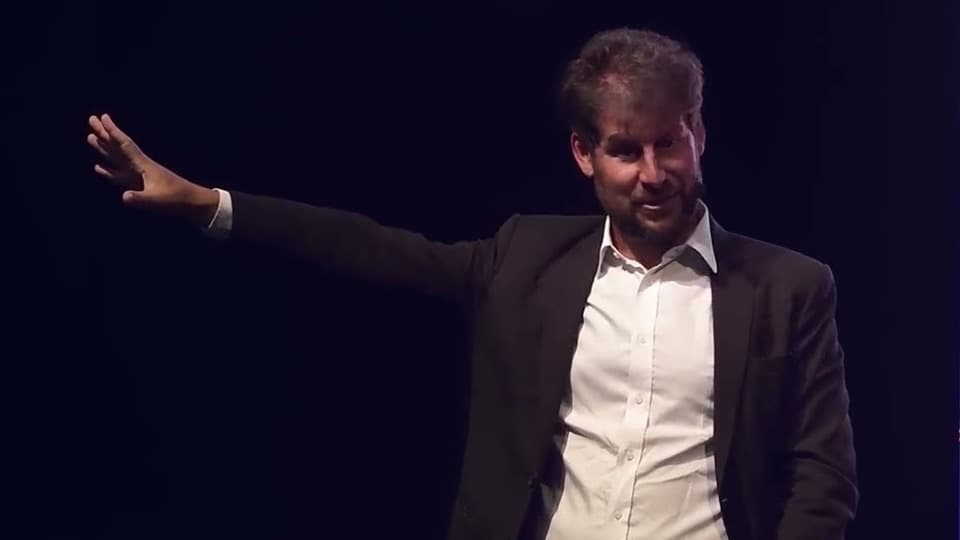
Rahim Taghizadegan at Liberty in Our Lifetime 2022
Why most intentional communities fail.
Twenty minutes on four waves of intentional communities, the real preferences behind the kibbutz, and why barriers to entry, the division of labour and parallel structures decide which communities last. Recorded at Liberty in Our Lifetime in Prague, 2022.
Transcript
The talk in full.
Lightly edited from the recording, in the speaker’s own words.
An intentional community for three days
Thank you. Thanks, Peter. So thank you for bearing with me, even though you would probably like to get a break right now. I have good news for you. Without knowing it, you've all been made part of an intentional community already. But don't worry, you only get the good stuff, not the bad stuff. It'll be an intentional community for three days.
Why is it an intentional community? I hope that every one of you came out of your own volition. I can't guarantee that, but I hope so. And certainly we share values and we share ends, which are imagined future states of the world that we would prefer to the present one. We even have the condition for a stable community. If you pick out any two people in here and see how they get along with each other, I think the likelihood is quite high that they'll get along very well. That's why it feels that great, and I hope it feels good for you as well to be here.
Worse odds than a startup
But if we extended that intentional community beyond the three days, and because we like it so much, on Sunday we'd say: "Okay, we're not going home. Let's choose a place immediately, settle down and become neighbours," interestingly, the bad stuff would appear. And that's the first interesting fact about intentional communities: the failure rate of intentional communities is even higher than the failure rate of startups. 97% fail eventually. 90% fail almost immediately, right at the beginning.
It's hard to say how many there are, because whenever you start counting them, they disappear and new ones emerge. One of the directories has about a thousand. And interestingly, the largest part of them is in the United States. The US seems to be quite a fertile ground for intentional communities.
Four waves
And the reason for that is that we are already in the fourth wave of the creation of intentional communities, so it's quite some track record. The first wave appeared in the 18th century, when people were seeking pure religious intentional communities to survive in a corrupted outside world: the religious utopias, amazingly interesting experiments in living together, from which we can learn quite something. The second wave was then in the 19th century, another religion, but a secular one: socialism. We had the socialist utopias. Interestingly, the US was a very important field laboratory for socialist utopias. The third wave started in the sixties: the hippie utopias, another re-emergence of intentional communities.
And we are in the fourth wave right now. It had some precedents in the seventies, it got its first momentum at the great financial crisis, and it has gotten new momentum right now during the pandemic times. I've never seen in my lifetime so many intentional communities being created, or people wanting to create new intentional communities.
These waves seem very different. What's the fourth wave? It's people seeking independence from a fragile financial and political order, and they seek that independence within more self-reliant and mutually supportive communities. So that seems quite a different approach. I'm quite optimistic about this last wave, but there are huge similarities to the other waves.
And what are the similarities? If you look at these projects, they look alike. They're rural, more agricultural. It's people seeking a refuge that is in nature, secluded, safe, with sane people, people that think more or less alike, starting new neighbourhoods, in particular to raise families. And all those different efforts always had a kind of communal property. But the range of communal property goes from full-blown communism to just cohousing.
What Nozick missed about the kibbutz
The first lesson we can get from history is to figure out the real preferences of people on this spectrum. There's a famous argument made by Robert Nozick. Nozick came to the conclusion that the US isn't really the perfect laboratory; there's a much better one. Because in the US, the intentional communities were usually regarded by the majority population as crazies, so you had some social pressure against going there. But there's one place on the planet that was settled, or meant to be settled, by intentional communities, and if you chose an intentional community, you got high prestige. You were encouraged to do so. And it's Israel. Zionism really planned to settle the whole of Israel by intentional communities called kibbutzim.
Nozick looked at how many people would choose a kibbutz and said: well, 6% in Israel. And then he made two wrong assumptions. The first one: "Well, let's be generous. Just 6% already shows it's a minority. Let's add another 3%, because probably a lot of people would like to join but can't, because their partner doesn't like it and so on." I don't buy that argument, because it goes the other way around as well. So he arrived at 6 to 9% who would voluntarily choose a mostly communist intentional community.
Now, if you look at Israel right now, you see the second wrong assumption: he didn't look at the tendency. The tendency was already going down at his time. It has arrived at about 1.3% of Israelis still living in kibbutzim. And that's not the most important part. It was not just people choosing to go away from full-blown communism; it was the kibbutzim themselves. Now three quarters of kibbutzim are not communist at all anymore. They're based on private property, they have market-oriented companies, so they're more like company towns. So you arrive at about 0.3%. And you see how ridiculous the notion is that socialism or communism was in any way related to democracy or something democratic. And then we are frequently attacked as undemocratic for trying to give the 99.7% a chance to choose something. I mean, how crazy is that?
Why not community as a service?
So I think there's already quite something to learn from that preference. But still, there is a case to be made for more communal arrangements, and I'll try to explain to you how come. First, it seems that people naturally prefer some kind of community. There seems to be a natural human need for community, for belonging. And of course it's always safer not to try to change human nature, but to accept it as it is. But the question is: why isn't community just offered as a service? Why won't entrepreneurs offer that? And of course they do. There are plenty of projects offering community as a service. But interestingly, there are other reasons why there is still space for intentional communities, and we can see them throughout history.
Stationary bandits and the price of mobility
If we look early on, we figure out that there was never a kind of free utopia in the past. There was always a distortion around people making their choices. And one of the biggest distortions, of course, is the political one: we are all facing political structures which can be described as stationary bandits. So there's quite some plundering. And this plundering leads to a premium on full mobility. There's an artificially increased pressure to become more mobile. It was so in the past; that's why the biggest wealth in the past was built by mobile networks of merchants, in Northern Italy and the Hanse. And nowadays it's the same. The easiest way to increase your individual liberty is to become a PT, a perpetual traveller or permanent tourist.
But there is a downside to this mobility. If you want to build up something in the long term, like raising a family or building industrial production, there seems to be a downside. And that's one of the major reasons why the Hanse was outcompeted by the then emerging financial and industrial centres, which somehow found a compromise with the stationary bandits.
Directly related to this distortion is another one: the whole incentive structure is distorted. The earliest entrepreneurs, when the term was found to describe a group of people, figured out that sometimes the best business is to be made with the stationary bandits and for the stationary bandits. That's just how incentives are. So the earliest entrepreneurs, when the term was used, were actually tax farmers, or soldier farmers, or war financiers and so on. That's quite a dilemma.
Barriers to entry
You see this bad distortion today as well. What would people associate when they think about community as a service? The company I would think of is WeWork, a bloated mess of a company. There's one even worse that unfortunately hasn't failed yet: Meta. That's the kind of thing you think about. And you see, of course, there is some space for more bottom-up intentional communities. Because how do you withstand these kinds of bad incentives and plunderers, and still create something with a long-term perspective?
You need a group of people with a very long-term perspective. And one of the success recipes for a long-term perspective is having a barrier to entry: make it costly to take the decision. Financial barriers to entry, obviously: 100% of intentional communities fail that have no financial barrier to entry, where it's like, let's start a community right away, everyone who comes can stay and decide with us how to spend someone else's money. But there's a problem. Usually the people able and willing to finance such a settlement are not exactly the same people who are willing and able to settle within these communities.
So there were some more important barriers to entry, and that's the reason for the importance of religion within the history of intentional communities. Religion can be understood as a quite costly barrier to entry into a community, and we see a very high correlation between the success rate of intentional communities and things like celibacy, asceticism, taking vows. And of course the most successful form of intentional community is the monastery. Monasteries are underestimated in their importance for culture, economic development and technological development. The reason is the distortion, of course: within a distorted, plundering structure, it just worked for those entrepreneurial creators of monastic orders. It was just a place where something with a very, very long-term approach could survive and build something for the future, things we still benefit from.
But of course, with celibacy you won't be able to survive without a constant influx of people and money. And that's true for almost every intentional community we look at. Once you have a reason for an influx of people and money, survivability is a bit more assured.
Division of labour, knowledge and uncertainty
So what are other reasons for the success of intentional communities? Why isn't it just an entrepreneurial offer? Indeed, the more alike they are to entrepreneurial projects, the higher the success rate, which means you have differentiation. One of the main reasons why you go for entrepreneurial projects is that we know we need a division of labour, and not only that, we need a division of knowledge. We learn from Hayek, and we learn from Mises that there is a division of uncertainty as well. Not everyone is equally able and capable to bear uncertainty. And that's one of the main reasons why spiritual communities fail. The founders have some hidden, esoteric knowledge and think they know it all, but they are unable to bear the uncertainty of an uncertain world, and they're just not good entrepreneurs. So that usually fails.
There are other reasons behind the more successful intentional communities. Monasteries figured out something else, and it's related to the more communist style. I mean, even communism is of course a barrier to entry, if you look at real preferences, not expressed preferences: the demonstrated preferences of really living a life like that. You give up your property, and then of course a barrier to entry is a barrier to exit as well. If you leave, you have to leave behind everything that has been built up. But there's also something else we know from psychology: shared physical activity actually leads to bonding. Shared work, but also shared rituals, shared dancing, shared singing and so on. That creates bonding and stabilises intentional communities. So there are quite a lot of things that monasteries got right, and partly they were even quite entrepreneurial, with a division of labour, division of knowledge, and in some cases division of uncertainty.
Parallel structures
Now, what else increases the success? And that's exactly the topic of our intentional community here: parallel structures. If you look at the distortion, you can appreciate the need for parallel structures. A lot of people who live in intentional communities would enthusiastically tell you about their day-to-day experience. They say: "Oh, it's so wonderful. I provide the milk for my neighbour, and the neighbour provides the honey for me. Isn't it beautiful?" And of course we'd say: "Yeah, you discovered something really beautiful. It's not very original. It's trade." And they'd say: "No, no, it's not trade, because we are not using money, and that's why it's so beautiful." And of course the answer is: no, it's not that you're not using money. It's that it's not taxed and no one is taking a cut. That's why it feels so nice to be really exchanging value with someone else.
So these kinds of parallel structures help cooperation. Then in financing, of course, you have parallel structures. Access to credit and debt is highly unequal in the financial structures right now. So all of these projects are figuring out how to do crowdfunding, how to start cooperatives, and those are parallel structures. And some of the more successful intentional communities, like an ecovillage called Cedar Moon, even started out as projects opposing credit-financed structures, just to protect a plot of land. You feel that there's something distorted in a kind of development. It's not just that you're against development; you feel it's ugly, it's destructive, and you want to avoid it. So you try to figure out how to buy the plot of land and do something better with it. That's actually quite a good reason, and that's a parallel structure as well.
What other parallel structures are there that help explain it? Partly it's really about overcoming labour laws, for example: it's run like a family or a cooperative, and you have everyone working. One of the most important non-religious intentional communities in the US, called Oneida, was actually transformed over time into a company for silver cutlery and was then sold to a fund. Another of the more successful ecovillages, called Twin Oaks, actually has three companies, and they make almost a million dollars a year. How do they make money? They use the labour of their members to weave hammocks. Ecological vegan hammocks, of course. But they are quite successful entrepreneurially, in a kind of parallel structure. So the best of them figure out how to use parallel structures.
Bitcoin citadels and free cities
And then of course there's the kind of intentional community that is part of this fourth wave now: Bitcoin citadels. I'm more involved with those kinds of projects, and they're obviously even using a parallel monetary structure. So I think a large part of the reason for success, due to the distorted structure, is that parallel structures actually help survival.
I'd say that's quite close to what free cities try to do. I'd predict that some of the best places to create intentional communities will be free cities in the future. I think we are natural allies, even of the 0.3% who would go for outright communism. Because if it's your free choice, if it's your volition, you've got to try it out. And I'm pretty certain that there is a number above zero for projects like that, and they may just find the right parallel structures and circumstances to start their own intentional communities.
But I expect that most intentional communities will be a bit further away from that. And if you look at the history of intentional communities, almost all of them started out with ideological certainty, and then it's a process of trial and error. They figure out that some things just don't work, they reduce the proportion of shared, communistic property arrangements, and get closer to a company town, a cohousing project, a residential project.
As I said, there are some reasons why it's not just one entrepreneur offering it as a service. If we had perfectly free circumstances, I would guess the most successful projects would be those provided as a service by professionals, to do the division of labour, knowledge and uncertainty. But with the world that we have right now, I think it's quite obvious why we have a fourth wave of creation of intentional communities, why it holds a lot of promise for a lot of people, and why we can continue learning from those experiences. We will need to learn a lot from these experiences also for the more anonymous nodes of free cities in the future.
So let's look forward to a future of intentional communities and free cities. I think it's exciting times. We've never seen so much momentum in both fields, and they are natural allies. Thank you for your patience.
On stage